
How to Be Creative in Ten Steps
I am often asked a variation on the question “Where do you get your inspiration?” or “How can you be creative?” It’s not a question that I have a three second answer for but I’ve thought about it a lot and compiled this answer to how I get my most creative photos and I believe that anybody should be able to follow these ten steps to get fantastic creative results.
Step 1: Learn Your Tools
I started with a camera when I was fourteen or fifteen. Much of what I did was experimentation with the camera that I appropriated from my father. I didn’t experiment blindly, I read about the technology and my father explained a lot of it to me. Nevertheless, don’t underestimate the value of formal education in both theory and technique. I found that I got much better results after I took a class at Oakland Community College. I learned enough darkroom chemistry that I built a darkroom at home and spent a lot of time taking photographs. At that time I photographed everything but was already drawn to particular themes that I am still exploring today: Vibrant color, people, and long exposure photography.
Step 2: Imitate
This is more of an exercise to get your creativity flowing than an attempt to create finished works. If I gave you all of the paints, brushes, and canvas needed to make the Mona Lisa, could you make a copy that I could not tell apart from the original? I doubt that I could. I often see things that I try to imitate. I think about the techniques used and then use them as a jumping off point. I intentionally allow myself to stray from the original. Often I don’t imitate a famous work, but I’ll show you a couple of famous works where I knocked off the concept. My version of the Vitruvian man uses fire and my version of the scream is just an excuse to use a photo I snapped of a model laughing that I thought looked like it belonged in the scream. It is the playing with imitation that is the jumping off point for getting a new set of techniques or concepts that you can make your own.


Step 3: Learn More Tools
I am always learning new tools. When I resumed doing photography a few years ago I learned digital photography. Although many of the concepts carried over from film I learned new things, including autofocus, new sets of camera controls, and file types. I added Lightroom and Photoshop to my arsenal of tools. I am constantly learning more, either extensions like the Nik collection or just new features and techniques in Photoshop. I took formal courses at Lansing Community College and although I knew a lot going in, doing so let me fill in some gaps, gave me an independent assessment of where I was weak, and helped me consolidate what I’d already learned.
Step 4: Experiment
I love to try new things. Sometimes they work, sometimes they don’t. I’ve had photographers tell me that the difference between an amateur and a pro is that the pro doesn’t have bad shoots. My answer was that the only way never to have bad results is to never push yourself to try things that are so hard that they might fail. My biggest challenge has always been getting models and one of my big fears is that models will see me experimenting, decide that I’m an amateur, and not shoot with me again. So, I often try easier things with new models. I shouldn’t and so fight against it. There will be a lot more detail on this topic in my essay on The Things I Keep Relearning as a Photographer. Suffice it to say that trying to do harder things is well worth failing every once in a while. I had a photo in my head that took thirty years and four tries to get right, but now that I have the technique down it has produced great results.
Step 5: Try to Salvage Failures
I had a shoot scheduled with a body painter who was also a photographer and a model who I had never shot before. The model didn’t show up for the shoot. I was pretty upset so the body painter suggested that we ask a model that she was scheduled to shoot that afternoon if she could start earlier and squeeze in a body paint shoot. The model agreed but didn’t have transportation. We picked her up and started painting. By that point in time though, we were behind and they had another shoot to do. So, instead of the body paint we’d planned, leopard spots that would cover pretty much everything we just had time for a line of spots from her left shoulder to her right ankle. The photos were much too explicit for my taste. I told the model that I’d retouch whatever she wanted, but that they weren’t the artistic shots that I was looking for.
A couple of weeks later I went gallery hopping in New York with my wife and we looked at a lot of photography. I was struck by some photographs that would have been similarly explicit, but were tamed by photoshopping textures onto the skin. I can still picture many of the pieces with dried cracked mud or paint giving texture to the skin and turning the pictures from erotic to elegant. If they can do that, I can salvage my shoot I thought. I came back to Michigan, added astronomical images to my shots and six months later one was hanging in a high end gallery in Columbus.
I took a profile shot of a model at a group shoot, coincidentally held at the home of the same body painter, to do one of those faces that can be seen either as a straight on face or a profile, depending on how you look at it. I wondered why they almost always were of males, and so I tried it with a female (and now I understand). Six months later I took some shots of trees outside my house to experiment with high dynamic range photography. The trees shots were OK but nothing special. Five months after that I decided that there must be something that I could do with the HDR tree shot that would be worthwhile. I added the tree shot to the profile picture to get one of my favorite double exposure photographs. The model came in for another shoot with me a few weeks later and I took more headshots and have been working on doing a series with all four seasons. I like three of the four.
Step 6: Try Many Things
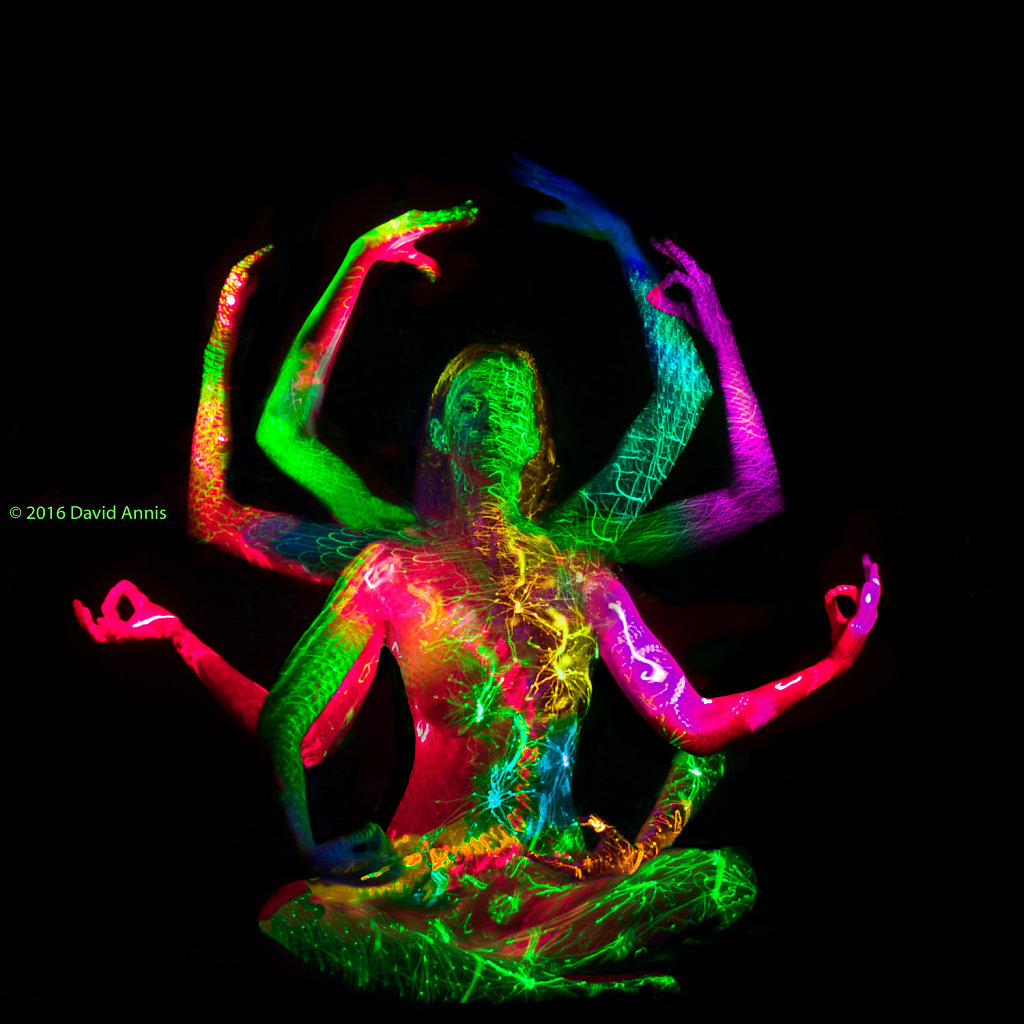
I know that at my core I am about beautiful color on the human form, but I will photograph flowers, nighttime scenes, glamor, stop motion, and many other things. I know that my core technique is colored light in studio, but I’ll photograph outdoors, in window light, or even in fluorescent lit hallways. Typically these forays into other genres and techniques produce work that I’m not particularly proud of, but sometimes I get a great shot and often the techniques I learn or elements of the shots that I take make it into my best works.
Step 7: Create What Excites Your Mind
When I took one of my photography classes, our professor, Ike Lee an inspiring photographer who truly loves what he does, would give us challenges every week. Go and photograph circles or rust or red. Some people would come back with amazingly beautiful and creative results. Usually, to put it kindly, I’d come back with mediocre stuff. It is not that I am not creative, it is that rust and circles don’t excite my mind. Sometimes I can take a challenge like that (the Mid Michigan Art Guild also has one every month) and create some phenomenal stuff. I took the challenge “white on white” and created a couple of nice pieces, using white light on white fabric and models in high key photographs. The reason that I rose to white on white but not red is that in one case I photographed what I have found makes my artistic brain excited and in the other I photographed cups and fire trucks.
Step 8: Find Great People to Work With
There are a huge number of people that make my photography happen. I already mentioned other photographers, teachers and mentors, but there is also a whole community of models, makeup artists, and body painters. Models bring ideas to shoots, and my shoots sometimes can be a back and forth, with each of us suggesting new ideas. I also collaborate with other artists, including a couple that I have only met online. I’ve worked with a body caster in Kansas City and a painter in Virginia.
Step 9: Combine Concepts
Try to combine concepts. I often composite photographs together that were originally standalone concepts. Here are a few examples.
Step 10 Extend Your Technique
Keep refining what you do, learn more tools, create more works, fail more times. The results will get more interesting.
These steps obviously don’t need to be done in order, but you can try them that way. By the time you get to Step 8 you’ll be producing great results. Drop me a line and let me know how it works for you and what other ideas you have.
David Annis